
Anal fissure treatment in Dubai — break the spasm, let the tear heal.
Also called an anal tear or a cut in the back passage, شرخ شرجي. Most patients describe it as passing broken glass.
A fissure is not just a cut. It is a cut held open by a muscle that will not relax and a blood supply that cannot reach it. Laser treatment releases that spasm with millimetre precision and stimulates the tissue to close — without the incontinence risk that follows a conventional open sphincterotomy.
- A tear in the anal lining triggers a reflex spasm of the internal sphincter
- That spasm squeezes shut the small blood vessels the tissue needs to heal (ischaemia)
- A poorly-supplied wound heals slowly, or not at all, and tears again with the next bowel motion
- Laser treatment interrupts the cycle by releasing the spasm — allowing blood flow, and healing, to resume
At a glance
- First line: 6–8 weeks of medical therapy — genuinely, not as a formality
- Procedure: laser sphincterotomy + laser fissure photo-biomodulation
- Theatre time: 10–15 minutes
- Pain relief: most patients report a marked change within 48–72 hours
- Work: 24–48 hours
- Best for: chronic fissure that has failed medical treatment
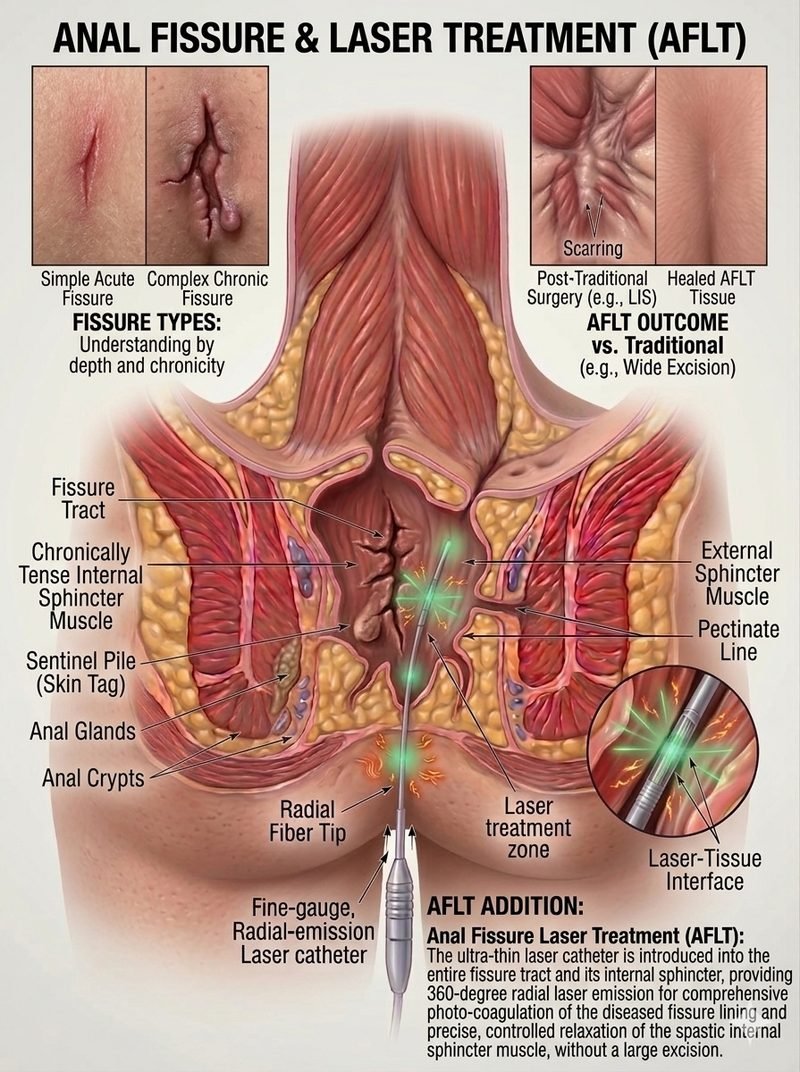
The condition and the cure, kept separate
Most fissures never need an operation. Read Component A first — it may save you one.
What an anal fissure is — and why it will not heal
An anal fissure is a longitudinal tear in the anoderm — the specialised, richly innervated skin of the lower anal canal. That innervation is why a tear a few millimetres long can produce pain out of all proportion to its size. Patients routinely describe it as passing broken glass.
Almost every fissure starts with a single hard stool. The interesting question is why the tear does not simply heal the way a cut on your hand would. The answer is a self-sustaining cycle:
Tear → severe pain → reflex spasm of the internal sphincter → raised resting pressure → reduced blood flow to the posterior midline → the tear cannot heal → the next stool tears it again.
The posterior midline — the six o'clock position — is where more than 90% of fissures occur, because it already has the poorest blood supply in the anal canal. When sphincter pressure rises, that is the first territory to become ischaemic. This is the entire rationale of treatment: it is not the tear that needs fixing, it is the pressure.
After around six to eight weeks a fissure is called chronic. The edges become fibrotic and rolled, the fibres of the internal sphincter may be visible at the base, and a sentinel skin tag forms at the outer end with a hypertrophied anal papilla at the inner end. At that point creams alone are unlikely to succeed.

Symptoms — the pattern is unmistakable
The classic triad
- Sharp, tearing pain during defaecation. Sudden, severe, and instantly recognisable.
- A deep burning ache afterwards lasting from thirty minutes to several hours. This is the sphincter in spasm, and it is often worse than the initial pain.
- Small amounts of bright-red blood — streaks on the paper or on the surface of the stool, never mixed through it.
Additional features: visible or palpable skin tag; intense fear of opening the bowels, which creates constipation and worsens everything; and — in the UAE's long working day — an inability to sit comfortably through meetings or a commute.
Fissure or piles? A quick differentiation
| Fissure | Piles | |
|---|---|---|
| Pain | Severe, sharp, defining | Usually none |
| Bleeding | Streaks, small volume | Can be dripping, larger |
| Lump | Small fixed tag | Soft, prolapses and reduces |
| After stool | Burning ache for hours | Settles quickly |
Acute vs chronic — this determines whether you need a procedure at all
Acute fissure
A clean, superficial tear with sharp edges and no secondary features. Around half will heal with conservative treatment alone, and a good proportion of the rest with topical therapy.
- Fibre to 25–30 g daily and 2–3 litres of water — non-negotiable in this climate
- Osmotic laxative to keep stool soft for the full six weeks, not three days
- Warm sitz baths 10–15 minutes twice daily — genuinely relaxes the sphincter
- Topical GTN or diltiazem to lower resting pressure chemically
- Topical local anaesthetic before defaecation to break the fear cycle
Chronic fissure
Fibrotic rolled edges, visible internal sphincter fibres at the base, sentinel tag and hypertrophied papilla. Spontaneous healing is now unlikely because the ischaemia is established.
- Topical treatment failure rate rises steeply after two months
- GTN headaches cause many patients to abandon treatment early
- Botulinum toxin gives temporary relief; relapse is common as it wears off
- This is the point at which a procedure becomes the reasonable option
Understanding your fissure
- A high-fibre diet and 2 litres of water a day — softer stool is the single biggest factor
- Warm sitz baths 2–3 times daily to relax the sphincter and improve blood flow
- A topical relaxant cream (e.g. GTN or diltiazem) applied exactly as prescribed, twice daily
- Simple stool softeners so the next bowel motion does not re-tear the fissure
- Fissure: sharp, tearing pain during and for some time after a bowel motion
- Piles: usually painless bleeding, or a lump — pain is less typical unless thrombosed
- A visible tear at the back passage on gentle parting points to a fissure
- The two can coexist, which is why an examination — not guesswork — confirms it
Laser sphincterotomy and fissure healing, step by step
Laser treatment of a chronic fissure addresses both halves of the problem in a single sitting: the pressure that causes the ischaemia, and the wound that will not close.
The release. A fine laser fibre delivers energy to a precisely defined segment of the internal sphincter, producing a controlled, graded relaxation of the hypertonic muscle. The critical difference from a conventional lateral internal sphincterotomy is dose control: a scalpel divides muscle to whatever depth the blade travels, and once divided it cannot be undone. Laser energy is delivered in measured increments, and the surgeon stops at the point where resting pressure has fallen sufficiently.
The healing. Low-level laser energy is then applied to the fissure bed itself — photo-biomodulation. It debrides the fibrotic base, stimulates local microcirculation and promotes fibroblast activity, converting a chronic non-healing wound back into an acute one that the body can actually close.
Where a sentinel tag and hypertrophied papilla are present, both are removed at the same sitting. They are not the cause of the fissure, but they perpetuate irritation and hygiene difficulty, and leaving them behind is a common reason patients feel only partly better.
For patients whose resting pressure is not elevated — a real subgroup, particularly older patients and women after childbirth — sphincter release is deliberately omitted, and treatment focuses on the fissure bed alone. Applying a sphincterotomy to a low-pressure fissure is one of the classic causes of avoidable incontinence.

Inside the theatre — the five stages
- 10–4 minutes
Anaesthesia and pressure assessment
Short general anaesthetic, spinal, or sedation with a perianal block. Resting sphincter tone is assessed under anaesthesia — and where available, anorectal manometry beforehand — to confirm that pressure really is elevated.
- 24–7 minutes
Examination and confirmation
The fissure is inspected, its position and chronicity documented, and coexisting pathology excluded. An atypical fissure is biopsied rather than treated.
- 37–11 minutes
Controlled laser sphincter release
Energy is delivered to a defined segment of the internal sphincter in graded increments, with tone reassessed between increments. The endpoint is a measured reduction in resting pressure, not a fixed depth of cut.
- 411–14 minutes
Fissure bed treatment
The fibrotic base is debrided and low-level laser energy applied to stimulate microcirculation and fibroblast activity. Sentinel tag and hypertrophied papilla are excised where present.
- 514–15 minutes
Finish
No packing, no sutures in the anal canal, no drain. You are awake within minutes and walking within the hour.
Watch it in motion
Benefits over conventional lateral internal sphincterotomy
Graded, reversible dosing
Energy is titrated in increments against measured tone. A scalpel cut is a single irreversible decision made in one second.
Lower incontinence risk
Conventional sphincterotomy carries a recognised risk of minor incontinence to flatus or liquid, quoted across series from a few per cent to over 15%. Controlled laser release substantially reduces that exposure.
Treats the wound as well
Photo-biomodulation of the fissure bed addresses the non-healing wound itself — something a sphincterotomy alone does not do.
Rapid pain relief
Because the spasm is released immediately, most patients notice a marked change in the character of their pain within 48–72 hours.
Day case, minimal downtime
Fifteen minutes in theatre, home the same afternoon, most patients back at a desk within 24–48 hours.
Suits higher-risk patients
Women with previous obstetric injury, older patients and anyone with borderline continence reserve — exactly the group in whom open sphincterotomy is most dangerous.
Pain: an honest comparison
0–10 visual analogue scale. The striking figure here is the first row: for most fissure patients, post-procedure pain is dramatically lower than the pain they were already living with every day.
Recovery timeline
The procedure, step by step
- The fissure and the underlying internal sphincter spasm are confirmed on examination
- A fine fibre delivers a graded, measured dose of energy to a small segment of the internal sphincter
- The endpoint is a controlled, partial relaxation — not a full division of the muscle
- The fissure itself is left to heal naturally once blood flow is restored
- We do not publish stock or invented testimonials on this site
- Patients who choose to share their experience — including years of chronic pain before treatment — do so in writing, with explicit consent
- Ask us directly and we can put you in touch, where a patient has agreed to be contacted
You should not have to dread the bathroom
Fissure pain is among the most disproportionate in medicine — a tear of a few millimetres that dominates your entire day. It is also one of the most reliably treatable things in proctology. Come in and find out which stage you are at.
How laser treatment compares with the alternatives
Conservative treatment comes first for everybody. This is what follows if it fails.
| Treatment | Healing | Continence risk | Trade-off |
|---|---|---|---|
| Fibre, fluid & sitz baths | Effective in a large share of acute fissures | None | Always first. Requires six full weeks of discipline, not three days. |
| Topical GTN / diltiazem | Good in acute, moderate in chronic | None | GTN headaches cause many patients to stop early. Diltiazem is better tolerated. |
| Botulinum toxin injection | Reliable temporary relief | Low, temporary | Wears off at 3–4 months; relapse is common. Useful as a bridge or a test. |
| Laser sphincterotomy + fissure laser | High in chronic fissure | Low — graded, controlled release | Treats pressure and wound together. Requires an operating theatre and anaesthesia. |
| Open lateral internal sphincterotomy | Highest reported healing rate | Recognised risk of minor incontinence | The historical gold standard — and the reason sphincter-sparing alternatives were developed. |
Insurance and cost for laser fissure treatment in Dubai
The question most people want answered before they book, answered plainly.
Typical published price in Dubai for anal fissure surgery: AED 10,000 – 18,000 (range across Dubai hospitals and clinics, checked September 2026 — not a quotation). These are Dubai market prices. For our own prices, click the cost page.
If you are insured. A symptomatic anal fissure is a medical condition, not a cosmetic one, so treatment is normally eligible under Dubai health plans. Eligibility is not the same as approval: almost every insurer wants pre-approval before a day-case procedure.
That pre-approval is prepared and submitted for you — consultation notes, diagnosis coding and the procedure request go to your insurer directly, so you are not the one chasing it. What your policy finally covers, and any co-payment or deductible, is set by your plan rather than by the clinic.
If you are paying yourself. You get a written quote before you commit to anything, itemised across consultation, procedure, anaesthesia and follow-up. No open-ended surgical extras appearing afterwards.
Both clinics — Swift Day Surgical Center in Jumeirah and Armada Medical Centre in JLT — work on the same basis.
Full pricing breakdown and the accepted insurer list: anal fissure treatment cost in Dubai and insurance cover.
Recovery timeline: most people are back at desk work within 48 hours
What the days after laser sphincterotomy actually look like.
Day 0. A day case. You arrive, the procedure itself takes around twenty minutes, and you go home the same day. No packing, no drain, no overnight stay.
Days 1 to 2. Soreness, rather than the tearing pain the fissure itself caused. Simple painkillers are usually enough, and most people with desk jobs are back at work.
Week 1. The first few bowel movements are the part people dread most. Fibre, water and a stool softener keep them manageable, and the spasm that drove the pain has already been released.
Weeks 2 to 6. The tear closes. For most people healing is complete inside six weeks.
What patients ask before booking
Will an anal fissure heal on its own?
An acute fissure often will, provided the underlying cause is corrected properly — soft stool every day for six full weeks, generous fluid, and warm sitz baths. Once a fissure has been present beyond six to eight weeks and has developed fibrotic edges and a sentinel tag, spontaneous healing becomes unlikely because the local blood supply is now compromised.
Why is my pain so severe for such a small tear?
The anoderm below the dentate line is somatically innervated — as sensitive as the skin on your fingertip — and it sits on a muscle that goes into spasm the moment it is injured. You are feeling a nerve-rich tear plus a sustained muscle cramp at the same time. That is why a 5 mm fissure can be more disabling than a much larger wound elsewhere on the body.
Is laser treatment safer than conventional sphincterotomy?
Regarding continence, yes — the release is graded and titrated against measured muscle tone rather than delivered as a single irreversible cut. Conventional lateral internal sphincterotomy has the highest published healing rate of any fissure treatment, but it carries a recognised risk of minor incontinence to flatus or liquid. The laser approach trades a small amount of that healing certainty for a meaningfully lower risk to your control.
How quickly will the pain improve?
Most patients notice the character of the pain change within 48 to 72 hours — specifically, the prolonged burning ache after a bowel movement is usually the first thing to go, because that is the spasm. Complete healing of the fissure itself takes four to eight weeks, and mild discomfort with a hard stool during that period is normal.
Can a fissure come back after treatment?
Yes, if the cause returns. The procedure resolves the spasm and the wound, but it does not change your diet, your hydration or your bowel habit. Recurrence is uncommon in patients who maintain soft daily stools and rare in those who do not return to straining. A written long-term bowel plan is part of your discharge, not an afterthought.
Do I need to try creams first?
In almost all cases, yes — and properly, for six to eight weeks, not abandoned after ten days. Topical diltiazem or GTN, combined with a genuine bowel regimen, resolves a substantial proportion of fissures without any procedure. If you have already completed an adequate trial and the fissure remains, you have earned the right to discuss a procedure rather than being sent round the same loop again.
I have a fissure after childbirth. Is treatment different?
Yes, and this deserves care. Post-partum fissures are frequently anterior rather than posterior, and the sphincter may already have sustained obstetric injury — sometimes an occult one. Any sphincter release in this group is approached with real caution and only after assessing existing function, ideally with endoanal ultrasound and manometry. In many post-partum patients the correct treatment is fissure-bed laser therapy with no sphincter release at all.
Could my fissure be something more serious?
A typical fissure sits in the posterior midline (or anterior midline in women), is single, and is exquisitely painful. A fissure that is lateral, multiple, painless, broad, irregular or associated with diarrhoea, weight loss or mouth ulcers is atypical and is investigated rather than simply treated — with biopsy where indicated — to exclude Crohn's disease, tuberculosis, sexually transmitted infection and malignancy.
How much does anal fissure treatment cost in Dubai?
Published prices across Dubai hospitals and clinics run from roughly AED 10,000 to AED 18,000 (checked September 2026), with a simple fissurectomy at the lower end and flap techniques for complex cases at the top. A fissure treated early is usually cheaper to treat than a chronic one with a sentinel tag and long-standing spasm. You are given a written, itemised quotation before you commit, and insurance normally covers treatment where it is medically indicated.
Related conditions
Hemorrhoids
Bleeding without significant pain points to piles rather than a fissure — and the two frequently coexist.
Compare symptomsAnal Fistula
If pain comes with pus or persistent discharge rather than bleeding, the problem is more likely a fistula.
Compare symptomsThe laser itself
Why graded energy delivery is safer than a blade, and the full safety profile of the technology.
Read the science