
FiLaC in Dubai — the fistula is sealed from the inside, the muscle is never cut.
Also called fistula-in-ano, ناسور شرجي (nasoor sharji) or भगंदर (bhagandar) — often described as a boil near the anus that keeps coming back.
A fistula is a tunnel. Traditional surgery lays it open, which means dividing whatever muscle lies across it — and that is where continence is lost. Fistula-tract Laser Closure works from within the tunnel itself, destroying its lining and collapsing it shut, with the sphincter left intact.
- A fistula is a small tunnel between the bowel lining and the skin near the anus
- Traditional "lay-open" surgery cuts along the tunnel — dividing any muscle in its path
- FiLaC destroys the tunnel's inner lining from within with a radial fibre, then it collapses shut
- Because nothing is cut, the sphincter muscle is never at risk
At a glance
- Procedure: FiLaC — Fistula-tract Laser Closure, 1470 nm radial fibre
- Imaging first: MRI fistulogram or endoanal ultrasound in complex cases
- Theatre time: 20–30 minutes
- Sphincter: not divided at any point
- Work: desk work in 2–3 days
- Best for: trans-sphincteric, high, recurrent and multi-tract disease
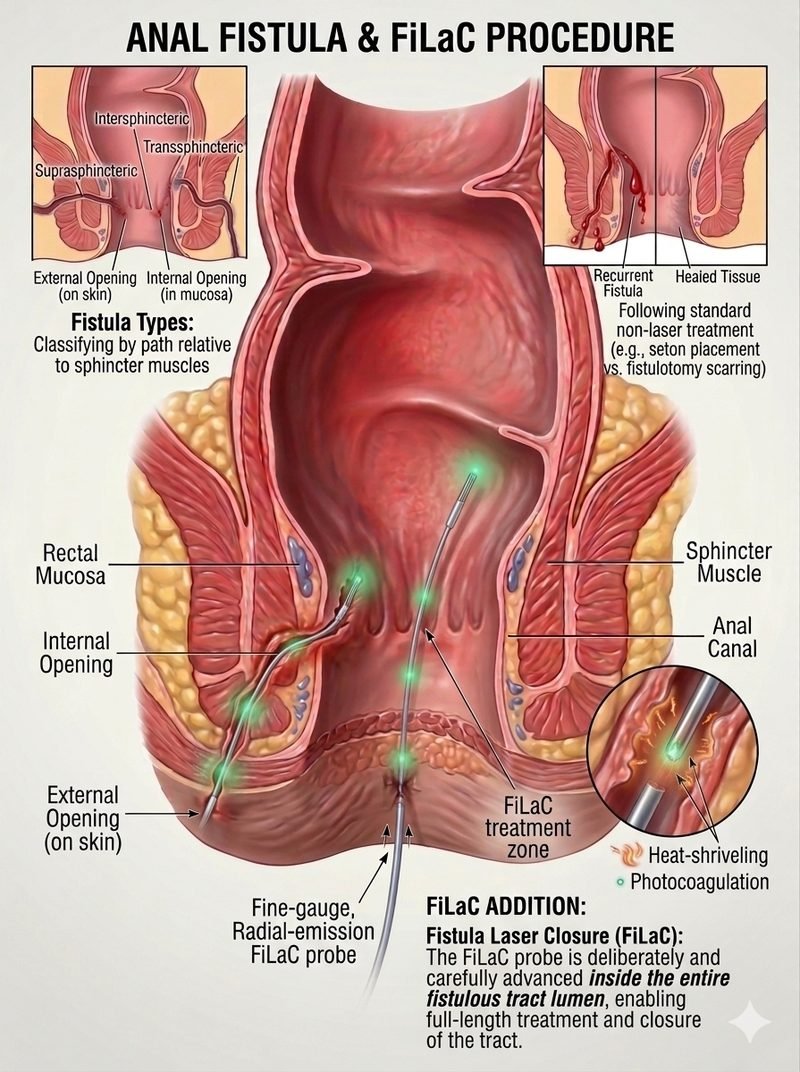
The condition and the cure, kept separate
Fistula is the condition where understanding the anatomy genuinely changes the decision you make. Start here.
What an anal fistula is — and where it came from
An anal fistula is an abnormal tunnel connecting the inside of the anal canal to the skin around the anus. It has an internal opening where it started, a tract that runs through or around the sphincter muscles, and one or more external openings on the skin that discharge pus, blood or faecal fluid.
Around nine in ten fistulas begin the same way. Small glands sit between the two sphincter muscles and drain into the anal canal at the dentate line. If one becomes blocked and infected, an abscess forms and takes the path of least resistance outward through the tissues until it discharges through the skin. That drainage path — the cryptoglandular theory — is your fistula. This is why so many patients say the same sentence: "It started as a boil that burst, and it has never properly healed since."
A fistula does not heal on its own. The tract becomes lined with epithelium and granulation tissue that keeps it open indefinitely. Antibiotics settle a flare, but they cannot close a tunnel. Only a procedure will do that.
A minority of fistulas arise from Crohn's disease, tuberculosis, previous radiotherapy, obstetric injury or malignancy. Identifying these matters enormously, because treating a Crohn's fistula as if it were cryptoglandular is a route to repeated failure. That is part of what your assessment is for.

Symptoms
The everyday picture
- Persistent discharge. Pus, blood or a yellow-brown fluid staining underwear. The single most reliable sign, and the one that makes patients wear a pad in silence for years.
- A small opening near the anus that may look like a spot or a dimple, sometimes with a visible bead of granulation tissue.
- Cyclical swelling and relief. The opening seals, pressure builds, pain increases over days, then it discharges and the pain vanishes — and the cycle restarts.
- Skin irritation and odour around the anus from constant moisture.
- Discomfort on sitting — long meetings and long drives become the worst part of the day.
When it is an abscess, not just a fistula
- Rapidly increasing severe pain over 24–72 hours, throbbing, worse on sitting.
- A hot, hard, tender swelling beside the anus.
- Fever, rigors or feeling systemically unwell.
- Difficulty passing urine or spreading redness across the buttock.
Classification — Parks types, and why it decides everything
The Parks classification describes how the tract relates to the two sphincter muscles. It is not academic: it is the difference between a fistula that can be laid open safely and one where laying it open would leave you incontinent.
Runs between the internal and external sphincter. The most common and the simplest. ~45%.
Low risk · FiLaC or fistulotomy both viableCrosses the external sphincter to reach the skin. ~30%. Height of the crossing is critical.
Core FiLaC indicationLoops up over the whole sphincter complex before descending. ~20%.
Sphincter-preserving technique essentialBypasses the sphincter entirely, entering above it. ~5%. Often secondary to another disease.
Complex · treat the underlying cause firstUnderstanding your fistula
- The primary tract — its full course between the internal and external opening
- Any secondary tracts or branches, including horseshoe extensions
- The internal opening, and its position relative to the sphincter muscles
- Signs of an undrained collection that needs treating first
- A missed secondary tract or branch that was never treated
- An abscess that was drained but the underlying tract left untouched
- The internal opening not fully closed at the first attempt
- A new, unrelated tract forming separately from the original one
FiLaC — Fistula-tract Laser Closure, step by step
FiLaC treats the tract as a cylinder to be destroyed from within. A thin radial laser fibre is passed along the whole length of the tunnel from the external opening to the internal opening. As it is withdrawn at a controlled, steady rate, it emits 1470 nm energy in a 360° ring.
That energy does three things at once. It ablates the epithelial lining that keeps the tract patent. It shrinks the surrounding collagen so the tunnel contracts inward on itself. And it seals the small vessels feeding the chronic inflammation. What was a cylinder becomes a cord of scar tissue.
The internal opening is then closed — usually with a small absorbable suture, sometimes with an advancement flap in more complex disease. Closing the source is essential: if faecal content can still enter the tract from the anal canal, no ablation will hold.
At no point is any sphincter muscle divided. The fibre passes through the tract, which already runs through the muscle. That single fact is why FiLaC exists and why it is the technique of choice for high trans-sphincteric fistulas, for patients who have already had sphincter surgery, and for women with obstetric injury who cannot afford to lose any further continence reserve.

Inside the theatre — the six stages
- 1Before the day
Mapping
MRI fistulogram or endoanal ultrasound reviewed and the tract drawn out with you, so you know the plan before you are asleep. In heavily infected or multi-branched disease a draining seton is placed first and FiLaC follows 6–12 weeks later, once the tract is clean and mature.
- 20–8 minutes
Examination under anaesthesia
Under spinal or short general anaesthesia the tract is probed gently, hydrogen peroxide or dye confirms the internal opening, and any secondary branches are identified and curetted.
- 38–14 minutes
Tract preparation
The tunnel is cleaned of granulation tissue and debris with a fine curette and irrigation. A clean tract ablates evenly; a dirty one does not. This step is unglamorous and it decides the outcome.
- 414–22 minutes
Laser ablation
The radial fibre is advanced to the internal opening and withdrawn at roughly 1 mm per second while emitting approximately 10–13 W. Energy density is kept constant along the full length so no segment is under-treated.
- 522–28 minutes
Closure of the internal opening
An absorbable suture closes the source. Where the opening is large or the tissue is scarred from previous surgery, a mucosal advancement flap is used instead.
- 628–30 minutes
Drainage and finish
The external opening is left open to drain — deliberately. A sealed skin opening traps fluid and causes the recurrences people blame on the laser. No packing, no drain.
Watch it in motion
Benefits over conventional fistula surgery
Continence protected
Fistulotomy — laying the tract open — carries a real risk of impaired control when significant muscle must be divided. FiLaC divides none. For high tracts this is not a preference, it is the whole argument.
No large open wound
Conventional surgery can leave a wound needing packing for weeks or months. FiLaC leaves the small external opening and a tract that closes from within.
Repeatable without penalty
If a tract does not fully close, FiLaC can be repeated — because nothing was removed and no muscle was sacrificed the first time. Contrast that with a failed fistulotomy, where the tissue is simply gone.
Suits complex & recurrent disease
High trans-sphincteric, suprasphincteric, multi-tract, previously operated and anterior fistulas in women are exactly the cases where sphincter-sparing technique earns its place.
Day case, fast return
Home the same day. Desk work in two to three days rather than the weeks of dressing changes that follow a laid-open tract.
Minimal bleeding
The wavelength coagulates as it ablates, so the field stays dry and post-operative bleeding is uncommon.
Pain: an honest comparison
0–10 visual analogue scale at 24–72 hours. Fistulotomy's score reflects the ongoing dressing changes as much as the operation itself.
Recovery timeline
The procedure, step by step
- The tract is probed and its full length confirmed under direct vision
- A radial fibre passes along the entire tunnel from the external to the internal opening
- 360° laser energy ablates the tract lining as the fibre is slowly withdrawn
- The internal opening is closed; the tract is left to collapse and fibrose shut
- We do not publish stock or invented testimonials on this site
- Patients who choose to share their experience — including complex, previously-operated fistulas — do so in writing, with explicit consent
- Ask us directly and we can put you in touch, where a patient has agreed to be contacted
Bring your MRI. Bring your previous operation notes.
Fistula is the condition where a second opinion is worth most — because the classification, not the surgeon's enthusiasm, should decide the operation. Send your imaging on WhatsApp and it will be reviewed before you even come in.
How FiLaC compares with the alternatives
In fistula surgery, the choice is always a negotiation between healing rate and continence. Here is that negotiation, written out.
| Technique | Best suited to | Continence risk | Trade-off |
|---|---|---|---|
| Fistulotomy (laying open) | Low intersphincteric tracts only | Low if truly low; significant if the tract is high | Highest healing rate of any technique — but it buys that by dividing muscle. |
| Seton (draining) | Sepsis control, Crohn's, staging before definitive surgery | None | Controls the disease rather than curing it. Often the correct first step, not the last. |
| FiLaC (laser closure) | Trans-sphincteric, high, recurrent, multi-tract | Minimal — no muscle divided | Moderate primary healing; repeatable without further cost to the sphincter. |
| LIFT procedure | Trans-sphincteric with a well-defined intersphincteric portion | Low | Good results in the right anatomy; requires a discrete tract to ligate. |
| Advancement flap | High tracts with healthy rectal mucosa | Low to moderate | Effective but technically demanding, with a longer recovery. |
Insurance and cost for laser fistula treatment in Dubai
The question most people want answered before they book, answered plainly.
Typical published price in Dubai for anal fistula surgery: AED 10,000 – 18,000 (range across Dubai hospitals and clinics, checked September 2026 — not a quotation). These are Dubai market prices. For our own prices, click the cost page.
Dr Kerim Erdem Ulucay's own starting price (self-pay): from AED 8,000 for laser fistula closure (FiLaC) in a straightforward case at Armada Medical Centre, JLT. Fees at Swift Day Surgical Center and Trellis Hospital differ and are quoted after examination. Consultation: AED 400. Your own figure is confirmed in writing after the examination — see all our prices.
If you are insured. An anal fistula is unambiguously a medical condition, so treatment is normally eligible under Dubai health plans. Eligibility is not the same as approval: almost every insurer wants pre-approval before a day-case procedure.
Fistulas carry one extra step. The MRI that maps the tract is usually approved separately from the surgery itself, so there are two submissions rather than one. Both are prepared and sent for you — you are not the one chasing either. What your policy finally covers, and any co-payment or deductible, is set by your plan rather than by the clinic.
If you are paying yourself. You get a written quote before you commit to anything, itemised across imaging, consultation, procedure, anaesthesia and follow-up. No open-ended surgical extras appearing afterwards.
Both clinics — Swift Day Surgical Center in Jumeirah and Armada Medical Centre in JLT — work on the same basis.
Full pricing breakdown and the accepted insurer list: anal fistula surgery cost in Dubai and insurance cover.
Recovery timeline: most people are back at desk work within 48 hours
What the weeks after FiLaC actually look like — including the part most sites leave out.
Day 0. A day case. The tract is closed from the inside, so the sphincter is not divided and you are not left with the large open wound that a lay-open operation creates. You go home the same day.
Days 1 to 2. Discomfort rather than the daily dressing routine that follows conventional fistula surgery. Most people with desk jobs are back at work.
Weeks 1 to 4. Some discharge from the external opening is expected while the tract closes behind it. It reduces steadily. This is the stage that needs patience rather than intervention.
Weeks 4 to 8. The tract seals. You are reviewed to confirm it has closed rather than simply stopped draining.
What patients ask before booking
Can an anal fistula heal without surgery?
Essentially no. The tract becomes lined with epithelium and granulation tissue that keeps it permanently open. Antibiotics will settle an acute flare and creams will soothe the skin, but neither closes a tunnel. Left alone, a fistula tends to branch and cause repeated abscesses — and long-standing untreated fistulas carry a small but real risk of malignant change.
What is the success rate of FiLaC?
Published primary healing rates for FiLaC in complex fistula generally fall in the region of 65–80%, improving with a second session and with meticulous closure of the internal opening. Simple tracts do better than complex ones, and Crohn's-related fistulas do less well than cryptoglandular ones. You will be given a realistic figure for your specific anatomy rather than a headline number.
Will I need a seton first?
Sometimes. If the tract is actively infected, branched, or has never been drained, a soft draining seton is placed for six to twelve weeks. It is a thin flexible loop that keeps the tract draining while the inflammation resolves and the tunnel matures into a clean, single channel. FiLaC on a mature tract works considerably better than FiLaC on an angry one. It is a delay that buys success.
Will I lose control of gas or stool?
FiLaC is specifically designed to avoid this. The laser fibre travels inside the tract, so the sphincter muscle that the tract passes through is never divided. This is the principal reason the technique was developed, and it is why it is preferred for high tracts, for anterior fistulas in women, and for anyone who has already had fistula surgery.
I have Crohn's disease. Can I have FiLaC?
Often yes, but only as part of a joint plan with your gastroenterologist and only when the bowel disease is medically controlled. Sphincter-preserving techniques are particularly valuable in Crohn's because these patients frequently face repeated procedures over a lifetime and cannot afford cumulative muscle loss. Healing rates are lower than in cryptoglandular disease, and you will be told that plainly before you decide.
How long before the discharge stops?
Discharge usually reduces markedly within two to three weeks and stops as the tract fibroses and the external opening closes, most often between weeks four and eight. Discharge that increases after week two, or becomes thick and foul-smelling, should be reviewed rather than waited out.
Can FiLaC be repeated if the fistula does not close?
Yes, and this is one of its defining advantages. Because no muscle was divided and no tissue removed, a second session is technically straightforward and carries no additional continence cost. Where a residual tract is found, a repeat ablation with reassessment of the internal opening is usually offered at around three months.
Do I need an MRI before treatment?
For a simple, low, first-time fistula, examination under anaesthesia may be sufficient. For anything recurrent, high, multi-branched, or associated with Crohn's disease, an MRI fistulogram is strongly advised. Undetected secondary branches are the single commonest reason a fistula appears to recur — planning around a scan is far more reliable than planning around a probe.
How much does anal fistula surgery cost in Dubai?
Dr Kerim Erdem Ulucay's own self-pay starting price is from AED 8,000 for laser fistula closure (FiLaC) in a straightforward case at Armada Medical Centre, JLT, plus AED 400 for the consultation; fees at Swift Day Surgical Center and Trellis Hospital differ and are quoted after examination. Published prices across Dubai hospitals and clinics run from roughly AED 10,000 to AED 18,000 (checked September 2026). One tract or four is the main difference, along with whether a seton or an advancement flap is needed and whether imaging has to be repeated. If you already have an MRI from another hospital, bring it. You are given a written, itemised quotation before you commit, and insurance normally covers treatment where it is medically indicated.
Related conditions
Pilonidal Sinus
Also a discharging tract — but higher up, in the buttock cleft, and driven by hair rather than an anal gland.
Tell them apartHemorrhoids
If the discharge is mucus rather than pus and there is bright-red bleeding, piles are the likelier cause.
Compare symptomsThe surgeon
Complex fistula is where training and case volume matter most. See the credentials behind the practice.
Full CV